Saturday, 2 April 2016

Frogs

Darren Sammy had said this before the ICC World T20 2016 semifinal, "The guys who predict the results, I think they say it's 80-20 to India, so it feels like a David and Goliath. But people tend to forget that David won the fight." Goliath Frog 
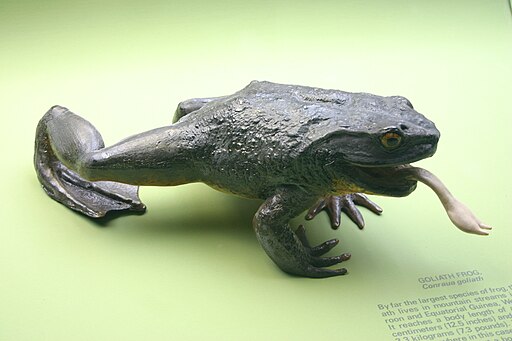
Well, people might have had different reactions to it, but I possibly had unique reaction - I was thinking of Goliath frog!!  
The largest specie of frogs is the Goliath frog, native to Africa.  Remarkable feature is that it has webbed feet! It is also the rarest species of frogs, thanks to the habitat destruction and collection for exotic pet trade.

There are many large number of species of frogs available all over the world. But, for now, let's talk of a couple of them here.
 
The  rare Indian purple frog of forests of Sahyadris looks gross with its weird characteristics. It is also rare and endangered by habitat loss. Look at its picture at your own risk. I will give you the link here. https://en.wikipedia.org/wiki/Purple_frog

Poison frogs are again remarkable for boasting venom on their skin. Inhabiting the dense rainforests of Neotropic regions (Central and South America). There are many species that fall under this category and colors range from red to larger blue ones. So, don't dare to get close to these beautiful and cute amphibians.

Saturday, 26 March 2016

Together, we are called...


We have often heard about collective names given to animals. Few things are simple.
 
Herd is used for deer, antelopes, zebras, giraffes etc.
Pack is used for wolves, jackals, dogs etc
Pod is used for whales, dolphins etc. 

Things start getting bizarre, now

Dinosaurs get two different nouns - herd is used for herbivores and pack is used for carnivores.

Crocodile's and alligator's groups have got different names. Crocodile's group is called as bask, whereas alligator's group is called as congregation.  And a group of calf alligator is not congregation but a pod!

Image courtesy of [njaj] 
at FreeDigitalPhotos.net
Apes are tailless primates like, gorillas, chimpanzees, bonobos, gibbons and orangutans. Group of apes is called shrewdness. But no ape species use shrewdness as collective noun. 

For ex. band of gorillas, cartload of chimpanzees and bonobos, buffoonery of orangutans!!

Well, if this not enough, imagine an animal using several collective nouns. Yes there are few of those oddities. 

A group of zebra can be called a herd, crossing, zeal or a dazzle.

A group of elephants can be called a herd, parade, memory or even a crash.  


Saturday, 19 March 2016

Introductions of disasters-2

Jumping to the second part, another killer introduction is that of the Cane toad in Australia. This amphibian has been the cause of deaths of several freshies, the fresh -water crocodiles of Australia. Actually, the toad's venom kills them after the freshies consume them. Luckily, Salties, the salt water crocodiles aren't get affected by their venom.

But, freshies aren't only victims of the Cane toads. Other victims  include three species of Varanid lizards, two venomous snakes (Death adder and Mulga snake).
Burmese python (6887388927)
Burmese pythons who have been introduced in Everglade swamps habitat (largely in Florida) are spoiling that ecosystem. These pythons prey on many native animals including the top predator of that ecosystem, the alligators. You could imagine how damaging it could be to the ecosystem. These bulky serpents were initially pets, whom people brought them from east Asia. They were later released into the wild by the ignorant pet owners who didn't know how they are harming the ecosystem. Now, many programs are launched to remove these large serpents for the ecosystem's wellness.

Saturday, 12 March 2016

Introductions of disasters-1

Man can cause disturbance to wildlife through activities like deforestation, poaching, climate change etc. But, there is another way in which he can destroy the wildlife population of species i.e. introduction of non- native species. While introducing, he should be careful about how this animal can harm the ecosystem.

There are many cases in which he introduced many non-native species.  Let me discuss two popular cases. 

Dating back to 19th century, when the Australian outback(semi-desert plains) was filled with many native marsupials, man introduced non-native species like camels(Most are Arabian but some are Bactrian) which were previously domesticated and then turned wild. Now, these animals have grown in giant numbers that people are finding it impossible to control their numbers. They have already eaten in such a way which caused native plant species to become threatened. Nearby infrastructure is also destroyed by them. Also, they drink tons of water.
Image courtesy of [by photokanok] 
at FreeDigitalPhotos.net
Other animals introduced in Australian wildlife habitats are cats,red foxes,rabbits, Indonesian water buffaloes, donkeys,horses, pigs which are now feral (wild). Both red foxes and feral cats also ruin by preying on smaller marsupials which are now threatened whereas rabbits like camels also eat so much plants that not only those plants are threatened but another  vegetarian marsupial i.e. the wombat has to compete with them. 

Image courtesy of [ by tungphoto] 
at FreeDigitalPhotos.net
St Helena island was discovered by Portuguese in 1902. They brought the goats to provide vital provisions for the passing ships. As their population became gigantic, they feasted on plants of the island. The island had a unique flora of 49 species of plants and 6 of them were not to be found anywhere else in the world. Many plants entered into list of extinct flora like String wood, Burchell's bellflower, St.Helena ebony etc. 

How sad that these plants no longer exist. If they had, they could have had some value to us or for the ecosystem.

Saturday, 5 March 2016

Deadliest of Australia-3

Image courtesy of [by M-Pics] 
at FreeDigitalPhotos.net

Here is the third list of the deadliest who we need to be careful of!

The dingoes,  Australia's wild dog, found in the Australian outback are no doubt the deadliest as people get deceived by their appearance and behavior like a tame dog. Campers who go into their habitat feed them treating like pet ones. Not safe! Dingoes are large, impressive predators who hunt, in packs like the Grey wolves and African wild dogs. They hunt kangaroos,wallabies and other smaller marsupials.  To say, they are the  only largest terrestrial predator in Australia. There have been incidents of dingoes injuring and killing humans. Don't get deceived by their physical characteristic features.
Sarcophilus harrisii taranna
The Tasmanian devil, having a small bear like appearance,  is honored as the largest carnivorous marsupial. Highly nocturnal, they feast on small marsupials, wallabies etc. Again popular for being a nasty predator as they are kleptoparasitical, i.e. who rob meals from other, predatory marsupials like quolls. Another deadly characteristic is their terrifying, threatening growl which can be heard from a distance only when the night sets in.
Textile coneBeware, sea divers!! The cone snail shouldn't be taken for granted as it is another deadly killer. The bigger species of this snail are more brutal. Venom is lethal to humans. When this tiny killer stings with its long proboscis being its deadly weapon, the effect won't be noticed but see after one or two minutes, the victim will receive symptoms like muscle paralysis,vision impairment, respiratory failure  and can be fatal. Immediate medical care is a must.

So, I conclude that whatever creatures I have mentioned in Australia's deadliest blogs (1-3) are no docile by any means and so shouldn't be underestimated

The macropods like kangaroos and wallabies can kick, box in defense and not to forget their sharp clawed feet and their sharp nailed hands. They are also great vehicle destroyers. Even ,the cute and cuddly koala bears and wombats can deliver powerful, wounding scratches from their sharp claws. So, even, these most known Australian animals shouldn't be taken for granted, although they are not the deadliest.

Saturday, 27 February 2016

Deadliest of Australia- 2 (Killer seas)

Image courtesy of [by digitalart]
at FreeDigitalPhotos.net


 But, if you are under impression that Australia's seas aren't dangerous and you can freely venture on those islands having a great time, think again.
The largest in the world, majestic, island of Australia boasts not only deadly terrestrial creatures, but also vicious marine killers. 

White shark


The biggest among carnivorous sharks- the great white shark is one among the deadliest sharks which we should avoid.There were large no. of reports of sharks injuring and even killing humans near to them, but the truth is that these marine killers confused humans as their prey like dolphins or seals.

Beautiful in appearance but vicious by nature,the blue-ringed octopus is another deadly killer characterized by blue- rings on its white body. 

We can even get a nasty sting if we step on the particular stones which are found in Australia's underwater. Don't mistake them for stones; they are the stone fishes, most venomous fish.

Same is true, for those surprise stingers found on Australia's beaches, the box jellyfish is no exception in being the deadliest known for many injuries and fatalities.

Saturday, 20 February 2016

Deadliest of Australia - 1

Image courtesy of [by digitalart]
at FreeDigitalPhotos.net
The smallest continent and the largest of the islands- Australia is known for its rich wildlife. But the key ones are marsupials- kangaroos, koalas, wombats etc. Even, there are other remarkable reptile species like the frilled lizard which is found only in this country, nowhere else.

But, be careful. Not to worry of crime rates, as they are low, but its vicious  wildlife which are daringly lurking around even in human settlements. So, a person visiting Australia should be careful of these deadly ones.

Image courtesy of [by M-Pics] at FreeDigitalPhotos.net
The largest reptile Salt- water crocodile (Estuarine crocodile) or salties called in short in Australia are actually one of the top predators in the Australia's riparian(rivers, billabongs, brackish waters) ecosystems.  
These reptiles are superstars in ambush attack. Any animal walking beside them, they come out of the water with great force and brings it down. They are also masters in jumping out of the water and snapping with their jaws in the cases when they are coerced with baits.
Infact, there are two species of crocodiles in Australia- Salties and the smaller freshies (fresh-water crocodile). Freshies too are dangerous but less harmful to us, but salties are deadly vicious.

Not to forget, even the slithering, scaly creatures like snakes are deadly killers as this country boasts many species of venomous serpents like Eastern brown snake, Inland taipan, Tiger snake etc. 

Don't underestimate spiders as they too are another group of deadly killers and are not smaller harmless ones.They are medium sized ones capable of inflicting pains to humans causing nausea and other feelings which require medical help. But, fatalities are rare.